Thursday, April 29, 2010
Thursday, April 01, 2010
Where did all the Christian writers go?
Friday, March 19, 2010
Why Theology Matters
DugDownDeep_Carnahan.mov from Covenant Life Church on Vimeo.
Fantastic video about why theology matters for all of us. Originally for Joshua Harris' Dug Down Deep.
Christianity Today has done some very good cover stories lately, and their latest one, The Mind Under Grace is very much worth reading. It's about how doctrine and life come together. A sample:
...we have to ask: Is it possible to live out discipleship without a good measure of heady doctrine? I see doctrine not as a boundary but as a compass. Its purpose is not to make Christians relevant or distinctive but rather to make them faithful in their contexts. Doctrine is a way of articulating what God's presence in the church and the world looks like. It can orient us by helping us, like Jon, major in the majors...Sarah Pulliam Bailey's side story Practically Theological investigates how teaching doctrine is making a comeback among younger evangelicals. My own experience in the UK, as well as in KL, where I have been doing some teaching, corresponds to this. And that is good news.
...Doctrine, while static at times, is meant to help us think about our lives more deeply by considering alongside other Christians the implications of our thoughts and deeds. Doctrine is wisdom that helps us clarify our mission.
As a side point, a few others and I have been reading a little of J. Greshem Machen's 1923 book Christianity and Liberalism, and he makes some great points of doctrine and life. That is, they should be in tandem, not in opposition, to each other.
Labels: culture, education, links, slice of life, theology
Sunday, January 03, 2010
Honouring your parents: a short bibliography
Greg Jao, 'Honor and Obey' in Following Jesus Without Dishonoring Your Parents, Jeanette Yep (ed.). Helpful, especially in looking at the relevant biblical texts.
*Marvin Wong, Honoring Parents in Between Friends: Reflections on Christian Discipleship in the 'Real' World. He summarises and builds on Jao's work with more sustained reflection. This is the single best thing I read.
Goh Kim Guat, Confessions of an Errant Child in Kairos Magazine, June 2003, Building Strong Families. An honest sharing of the struggles of caring for an aged mother, alongside a meditation on grace. Available here. One of my church members also shared a similar experience in our church newsletter which I also found helpful.
Also,
Sarah Lanier, From Foreign to Familiar
Denis Lane, One World, Two Minds
These are two short introductory books on crossing cultures. Though these books tend to be geared towards missionaries, they're also very helpful for building understanding across generations, I find.
Labels: books, culture, slice of life
Saturday, January 02, 2010
Latest on use of word "Allah"
The court on New Year's Eve overturned a three-year-old government ban that prevented the Catholic Church from using the term Allah in its literature. The Arabic word has been used by various faiths in this Muslim-majority nation for centuries, and the church argues that it is the only suitable way to denote God in the Malay language.
Read the whole thing.
Sunday, December 06, 2009
Thinking through ministry and parents
The past month has been difficult. I've felt really disheartened at various points. I've had a few...battles (the word doesn't seem quite right. Disagreements? Skirmishes?) with my parents once they realised that ministry wasn't just some passing fancy I'm into at the moment. While I didn't start my church apprenticeship 15 months ago by announcing to my parents: "I'm going to be a pastor/church planter/missionary for the rest of my life!", I think just doing the apprenticeship signalled that I was definitely exploring the call to full-time paid gospel ministry (thereafter I will simply use "ministry" or "full-time ministry" interchangeably to refer to this). When I sought counsel about the way in which I should engage my parents, the advice I receive was to keep them informed and to gradually open up to them some of my plans, so that it wouldn't be a bolt out of nowhere. I still think that was sound advice. And I believe that for the most part I have. I was up-front, for example, with the fact that I went to talk to a pastor in KL with a view to future options nearly a year ago now.
An apprenticeship is meant to be a testing ground to explore the call into full-time ministry, and simultaneously a stepping stone should it seem as if that call is to be pursued further. And to be honest, everything seems to be pointing that way. The work is very hard, make no mistake, but I love what I do. I appear to have teaching and preaching gifts, even if they still need to be worked hard at. Character, that most important of traits, is harder for me to judge, but I haven't been pulled aside and told that I have such serious transgressions as to be disqualified, if that counts for anything! :) Which is why I'm thinking about this seriously.
But it's hard to communicate with my parents about all this. My parents don't fit neatly into any box - on some fronts, they seem like very traditional Asian parents; on others, they have proved to be more open-minded. I'll say, for instance, that they were more positive about me embarking on my apprenticeship than I expected. Still, they've got a very different worldview from mine. And to be fair, the only models they have to go on are those in Malaysia. I noticed, for example, that they just don't seem to understand, despite me trying to explain it as clearly as I can multiple times (and believe me I've tried!), that people do get paid for this stuff, as yes, they do get paid enough to cover their basic needs at the least! Now, to be honest, I don't know much about pay structure and things like that in Malaysia for those in full-time ministry, but I am realistic enough to know that it's pretty low. (If you know more, please enlighten me in the comments!) In some harder situations, for example, a pastor will have to go bivocational. But that's not going to happen with me with the current options I have. I do think it will be hard. I come from a middle-class background, as is obvious from being able to go to university in the UK. So nice holidays abroad, for example, might no longer be easy to come by on a salary of your average full-timer. But it's not the end of the world.
There's also the "you can still work a full-time job and do ministry on the side" argument: this seems to be a favourite of Asian parents everywhere, as some of my other friends in ministry testify. Well, I had to explain the "full-time" in "full-time ministry", and the value of ministry of the word, but how do you do that when their worldviews are so different? It's made even more complex when I naturally advocate every-member ministry, i.e full-time ministry does not make you more inherently spiritual; there is a sense in which every Christian is full-time. But then to say that there is also a sense in which some people are set apart for full-time ministry. Regular readers of the blog will remember that I preached from Ephesians 4:7-16 over a month ago, which touches on this very issue. Frustratingly for me, it seems as if every church member apart from my parents understood what I was going on about!
And then there's the "you should gain experience in the real world first" argument. This one I've thought about long and hard, because this argument has validity. After all, I am very young. And I think every young person thinking about full-time ministry must wrestle hard with this. In the end, though, I think this one has to be decided on a case-by-case basis. Why? There are quite a few reasons. Firstly, it isn't always the case that you must experience something to be able to minister effectively into that situation. After all, no one person will ever experience the full range of possible experiences. If you get married and have kids, then you have traded off the experience of being single into your old age, and vice versa. Would you say the married/single person has nothing to offer the person of different marital status simply because he or she has never had that experience? Now, that's not to say experience in the working world is not valuable, and it could definitely give you unique insights that are not available elsewhere. What is it like to work for a prickly non-Christian boss? When everyone is busy handing out duit kopi? But I'm trying to say that it's not the clinching argument. For some, they will benefit from time in the working world. For others, it's not necessary.
Also, I do sometimes bristle at the fact that Christian ministry isn't the "real world". I've met up with a non-Christian managing director of a publishing company at least 10 years, if not more, older than me to read the Bible together and to talk about life. I've sat with a homeless person and warmed up his sandwich. I laughed together with PhD students and discussed pressing academic matters. I work in a cross-cultural situation as the only non-Western staff member of my church. Granted, my experiences of the world look different, but is this less "real-world"? The other thing to consider is the difference in age and how that dynamic works in an Asian culture. I've thought about it. And I think this means that it's definitely true that I probably won't gain a hearing from them initially. But does that disqualify younger ones like me automatically from ministry? No, it means I have to work hard at every aspect of my godliness, to be a bit more tentative in some of the things I say, to be quick to listen and slow to speak to older heads.
You probably think from my above two paragraphs that I've already made up my mind to go full-time straight away. Believe it or not, I haven't. I spoke to our long-term mission partner, who is a British-born Chinese (Malaysian and HK parents), when I was on a mission to X Country in the summer. He has first-hand experience of parental opposition. And he offered really good advice. One reason in favour of working a "secular" job is simply to grow up a bit. Now I think sometimes I am in need of that! But he cautioned against taking a secular job simply to "earn credibility". That advice takes on renewed force now that I know some of my mum's friends have been whispering amongst themselves about the son who went to a highly esteemed university but is thinking about taking a job that doesn't command much respect! (These are professing Christians, btw, and I confess to dreaming up some rather unChristian retorts). But that has made me pause about completely rushing in. At the same time, since I've been back, one thing that has been hugely emphasised is the urgency of the task. Malaysia is really lacking in full-time Christian workers, and more than one person has independently expressed their concern to me about the next generation and whether we lose the ground that was so hard-won. So there is definitely a part of me that simply wants to press on and not dither.
Oh, and of course, there's the classic Ephesians 6:2 argument, a favourite of all Asian Christian parents. I always think, how about verse 4? But what has helped early on is recognising honouring your parents does not mean obeying them in everything. Of course, we have to be careful - that doesn't suddenly mean you can justify your every disobedient action! But v.4 does provide supporting context. It's not just that parents are not to exasperate their children, but that they are to do so by instructing their children in the ways of the Lord. And so to honour your parents is to walk in the way of the Lord, in line with the task God has set them, which can sometimes mean not going with their every whim! (The mission partner I mentioned earlier also had some interesting exegetical support from Exodus, but I'm not sure I can completely recall it now so don't want to put words in his mouth).
Wow, you're probably thinking I've been so calm and reasoned! Trust me, I'm not. I have been upset with myself that I have gotten argumentative and defensive with my parents so easily and quickly! And I don't want to paint my parents as the veritable bad guys. I have to understand how their worldview and life experiences has impacted them, and I am actually confident that in the long term, they will be supportive. But it's been very disappointing not to feel their support now, though it was expected. And it is quite hard when you're treated like a kid when others treat you like an adult! They seem to think I've been very gung-ho when really, my temperament (and more importantly, the fact that God surely doesn't like impetuous fools) militates against it. Instead, I've been torturing myself with "should I or shouldn't I?"
Well, I was going to write more on some of the more disheartening moments in the past month, but those are nothing to do with parents, so that will have to be for another post. Comments welcome.
† Expand post
Labels: commentary, culture, ministry, missions, personal, personal reflections, slice of life, the church
Monday, November 23, 2009
If I were a Christian filmmaker/scriptwriter
Firstly, every person and every culture has a Big Story, one in which they both shape and are shaped by. Within this Big Story there might be many sub-plots. However, the movement in each of these stories will include in some form creation-fall-redemption-restoration. Any story will seek an answer, explicitly or implicitly, to the well-known four questions posed by Richard Middleton and Brian Walsh:
1. Who am I? Or what is the nature, task, and purpose of human beings?
2. Where am I? Or What is the nature of the world and universe we live in?
3. What's wrong? Or what is the basic problem or obstacle that keeps me from obtaining fulfillment?
4. What is the remedy? How do I solve this problem or where do I find salvation?
This includes films. It could be said, in fact, that films are one of the primary ways in which people attempt to make sense of their place in the world today. Whether they ponder over a so-called weighty film or simply seek solace in a light-hearted comedy, they are still in some way engaging in the task of sense-making. Every film, in summary, offers a vision of what the world is like, and how the world ought to be.
The Christian filmmaker or scriptwriter is aware that his faith claims to have the True Story. We understand that we are to understand humanity in light of God and of sin, and we know where redemption is to be found. Therefore, "it follows that storytellers in our Christian community carry a major responsibility for keeping us alert to these stories and the way they work." (Eugene Peterson). This is because stories can grab us in ways mere arguments can't, and stories always reveal something about their creators. "We feel the emotions, get caught up in the drama, identify with the characters, see into nooks and crannies of life that we had overlooked, realize there is more to this business of being human tan we had yet explored. If the storyteller is good, doors and windows open." (Peterson) So if I were a Christian film-maker or scriptwriter, then I must offer a vision of how the world is like, and how it ought to be, in line with a Christian worldview.
But how I go about that is up to me and my (imagined!) creativity! The possibilities are vast. Think of some recent films. The Dark Knight, for example, might seem to be the antithesis of what a Christian film-maker should offer, but one of the things the film does so effectively is offer a very chilling vision, via the Joker, of what a world ruled by chance and randomness rather than God would look like. This is not to claim that the Dark Knight is a "Christian" movie. Nonetheless, it is extremely effective at jolting us out of our complacency and opening our eyes to the hideousness of a fallen world. Any script that can do that is worth exploring, although I would never allow it to fall into a hopeless cesspool of despair. If in Genesis 3, God himself already offers hints of hope (v.15), then surely we should do the same.
But a Christian filmmaker doesn't have to be so "arty". I think one sort of film I might like to make is a romantic comedy which doesn't envision the partner as the saviour who "makes me whole". That would be incredibly counter-cultural. If it's done well, I think that would have a bigger impact than some "weighty" film. What the viewer of such a film will encounter is the truth that even Mr. or Mrs. Right can't function as your redeemer. What would be great too is a film that celebrates marriage, as most recently Fireproof does, given the dominant image of marriage in films to be dowdy and "a trap". [Spoiler alert] I can't remember much of the film Forces of Nature, but I do remember the ending, where the main character chooses to go back to his marriage partner instead of making off with his fling. That came as a genuine shock. I don't remember the rest of the film being very good, but if it had been better executed, then I can imagine that ending carrying a real poignancy and weight about it. [end spoiler alert]
Does a Christian filmmaker need to make an explicitly "Christian" film, i.e one in which the gospel is proclaimed? Well, they could. I would love to see a film with actual characters with an evangelical faith, not cardboard stereotypes, and if I were a good film-maker, I would love to explore such a character. But I don't think a Christian film-maker necessarily needs to do so. A film should rest on the foundational biblical storyline, and perhaps show the weaknesses of an alternative storyline, but it doesn't always have to be about the climax of that storyline (the gospel event). We could show the beauty in the everyday, in the nature of true friendship, for example. I'm thinking of something like The Station Agent. Or the nature of true sacrifice in some epic. And so on.
I suppose there's plenty more to be said, but hopefully that provides the beginnings of an answer!
You can also browse some of my previous posts on films
† Expand post
Labels: culture, films, imagination, personal reflections
Wednesday, November 18, 2009
Observations on being home
Reverse culture shock #1. After being in an egalitarian society where 70 year olds expect me to call them Mike, not Mr. Jones, and to discuss things on a peer-to-peer level, I'm finding myself a little confused about what is and what isn't appropriate to talk about with those older than me. I think it doesn't help that there're degrees of differentiation too! My family would be a bit more traditional and there's more of a hierarchical mindset, whereas my church is relatively speaking, much more relaxed. I suspect I'm erring excessively on the polite side.
Reverse culture shock #2. So when an uncle (in Malaysia, anyone who is reasonably older than you is often addressed as such, not just family. No responsibility is taken if you misjudge somebody's age!) offered me coffee, I said immediately: "Yes, please!" After watching his body language thereafter, I realised then that I should have played the "No No" game, making some tentative refusals before accepting his offer. Ergh.
Reverse culture shock #3. Most of the literature dealing with this subject note that symptoms often include
I think I've experienced bits of this, and it's reminded me that when I finally come back home long-term, whenever that might be, I would have to deal with this.
Theory and praxis. I think it was the veteran missionary Martin Goldsmith, who used to pastor a church in Malaysia, who said: "Asian (or was it Malaysian?) Christians are short on theology, long on ethics." By that he meant that Asians tend to dislike theoretical musings for its own sake, but want to see its connection to daily life, the "real world" if you like. Otherwise it would just be dismissed as irrelevant. This has positives and negatives. Positively, it immediately lends Christian reflection a pastoral and missional orientation. Theory and practice must not be separated. Negatively, this often leads to pragmatism, whatever works. They just want to know "what to do", and to think too deeply is "unspiritual". I bring this up because I am sensing this a little.
Bible study. I was also thinking about how our Bible studies work. In Asian Bible studies, it is common for people to immediately think about their own experiences and contexts and to share them as they go through a passage. I was previously very critical of this, and I think there is good reason to be. There's always the danger of reading our own experiences into the text and seeing things which aren't actually there. Tangents also often lead the group to chasing red herrings and completely missing the main point.
But I now think I've allowed myself to be over-critical. Rightly done, I see that there is a lot of value in just naturally intertwining our understanding on the passage with reflections on our lives. I've been observing my home fellowship group and though we don't always get it right (and to be fair, who does?), I thought that for the most part, whenever somebody shares or offers a reflection, it's been tied to the text and not just some random whimsy to offer a thought for the day. It's just their way in which they allow the Bible to bear on our lives. In fact, it's challenged me because I probably don't let God's word really peer as deep into my soul as it should. I suppose the cultural anthropologists might argue that this is because "Western" thinking is more linear and "Eastern" thinking is more circular. So while the principles remain the same: we need to know what the Bible says and means before we can apply it to our lives, there is a variety of models, and I know I can't lead a Bible study here exactly the same way as I would in the UK.
Social networking. Media commentators have picked up on this (eg: here, here, and here), but seeing it for myself was quite different. I was quite stunned by the virtual connectedness of the teenagers in my youth group. The amount of photos taken and placed on Facebook was quite something. Again, social commentators have noticed that we are once more heading into a world where the boundaries between the public and private spheres are blurred, as it was in a pre-industrialised age. But it's still jarring to see photos of myself that I didn't even know were being taken suddenly appear on the Net!
Spiritual warfare. I wasn't home for that long before I heard of a case of demon possession. Growing up, of course, it's not that rare to hear such stories, but it reminded me once again that it's certainly one area to think about for anyone wanting to do ministry in Malaysia. What you don't want is to capitulate to the latest faddish teaching on the one hand or to ignore the spiritual realm on the other.
Wrestling in prayer. I think I identify a little more with the psalmist now. "Lord, please help me to trust you. I know you are sovereign over all, I know that you are good, and that your plans are best, so whatever the outcome is, help me to accept it. [clenches teeth] Lord, help me not to be so half-hearted in what I just said. It's going to be hard if you don't allow me to go back, but help me to grow in my trust. But God, I do believe you are a generous Father, and that Christianity ain't fatalism. My prayers do count for something, don't they? So do the prayers of others? So I pray you'd allow me to head back - I don't see how that's a bad thing. [Pause] I mean, Lord, I'm not actually presuming to tell you what's best for me, oh no, not at all. But it's a fair request? [Pause] Ummm, but I know you're more concerned about me being more like Jesus, more concerned about being more like what you've made me to be than where I am. Consider it all joy and all that. So ummm, help me trust you again no matter what. [Deep breath] But...pretty please?" It's ping-pong prayer, back and forth, back and forth.
Sin. You'd like to think that you've grown stronger, and then you come into a stressful situation and learn that your sinful patterns are more entrenched than you realise. Thank God for his grace.
Labels: culture, Malaysia, personal reflections, slice of life, theology
Tuesday, November 10, 2009
Assimilation and identity
1. First generation - clear sense of identity. That is, their identity is very much tied to their "home" culture. They might develop survival skills to cope in the new culture, but their values, beliefs, things & events they find significant etc., are those of "home". If women come from patriarchal cultures, they are unlikely to be exposed much to the new culture, from staying at home etc., and so are often isolated.Also, at a deeper level, language becomes an issue. Hiebert and Hertig quote Cheryl, a Korean teenager in LA: "I try to speak Korean when I talk with my mother, but the most important emotional stuff I say in English because I cannot express it in Korean. So my mother does not have any idea what I am trying to say. It is really frustrating. I don't understand why she does not try to learn English. She has lived here almost twenty years." I think a few of us Malaysians will share similar experiences.
2. 2nd generation - deep identity crisis. They encounter schizophrenia, for at home and within the family, they absorb certain values and beliefs, but in school and public are enculturated into the new culture. So you have a clash, with this generation often having to make decisions about how much to take on board parental values, resulting either in withdrawal, rebellion, or more likely, compartmentalization. The best case scenario is if one is able to integrate the best of both worlds. Add in other factors such as the different paces at which siblings within a family might assimilate and it gets even more complicated. One critical factor in the assimilation of second generation young people is the attitude of their parents. Other factors like social mobility etc. all count for something too.
3. 3rd and 4th generation - assimilation and appreciation. Here the identity crisis is not so acute, because they have figured out their place in society more, whether by carving out a niche for themselves or completely assimilating. But when we get to 4th/5th generation, we find that some begin to seek their roots once more, especially if their racial features are more distinct. Here we may find the problem of "hidden immigrants" - eg. looking Chinese on the outside but born and bred in America, and so actually being completely different culturally.
So why am I blogging about all this? There's the personal side, of course: I have often wrestled with questions such as this partly due to my upbringing, my family and educational background, the friends that I have, and of course, as someone involved in ministry with international students in a Western country. And because I just wanted to see if I could stimulate some thoughts from my readers, and the article above provides some important intercultural, and indeed, intergenerational insights which are relevant for the Malaysian context, although obviously we are very different in many ways. I think, for example, of the differences between English and Chinese-educated Chinese and the questions of trying to "preserve" a culture versus the "interaction" of cultures. Or the often frustrating family dynamics that those of us who are younger struggle to decipher - why are parents always so obtuse? (Apologies for the examples being obviously Chinese, that's my makeup). Or the wider politics of race and racial discourse - would you describe yourself as Malaysian or Malay/Indian/Chinese/Bumiputra/Iban/Kadazan/Martian first? I actually assert my "Malaysianness" more, I think, but I know others will differ from me.
Some might take exception to using an article on the "immigrant experience" to draw parallels to the Malaysian situation, since "immigrant" itself is a contested term in Malaysia. A big number of us will resent being labelled as pendatang, as if we were 2nd class citizens. That, of course, is to miss the point. It's simply a historical fact that many of us will have ancestors who at some point immigrated to what we now call Malaysia. I know we live in a plural society, so I wonder if we're not so much assimilating into a clearly marked majority/mainstream culture as forging a distinctively "Malaysian" culture, although again what that is is up for debate. How do you compare Sino-Kadazans in Sabah with the Nyonyas in Malacca? But maybe again the lack of flattening is a good thing. It means we're more aware that we all have particular categories and assumptions that affect how we view the world.
Plus, these are questions, I am convinced, we need to reflect on as Malaysian Christians, especially as it impacts on things like pastoral practice, evangelism and so on. It also challenges us to consider afresh what it means to consider ourselves to be Christians first and foremost, to be sojourners in this age. As Tim Kellers notes:
"Identity is a complex set of layers, for we are many things. Our occupation, ethnic identity, etc., are part of who we are. But we assign different values to these components and thus Christian maturing is a process in which the most fundamental layer of our identity becomes our self-understanding as a new creature in Christ along with all our privileges in him."OK, I've rambled with no clear direction for long enough. Comments welcome. For more on the migrant experience, I can think of no better teacher than the short stories of Jhumpa Lahiri. For an intro to cross-cultural issues, try Sarah Lanier's From Foreign to Familiar or some of Duane Elmer's books.
† Expand post
Labels: culture, Malaysia, personal reflections, race
Sunday, November 08, 2009
Litany of complaints
I've been thinking about why I usually feel a little uncomfortable whenever the floodgates open. OK, so part of it is probably that by nature, I'm not a happy bunny when it comes to conflict. I like the still waters, not the grand rapids, thank you very much. Maybe I'm guilty of apathy. But I do believe that to pretend that all is well, to be tidak apa about the wrongs that the innocent suffer, the way that so many crooks seem to get away with their abuse of power, is wrong, plain and simple. It's also probably fair to say that in context, the 2008 political tsunami notwithstanding, such talk arises perhaps because there is a feeling that we need to be woken up from our general malaise. We can't maintain the status quo forever. So such conversations are full of heat and light.
And yet. Here are a few reasons why I feel unsettled whenever such talk occurs among Christians (btw, this isn't necessarily true of tonight's conversations; they simply sparked the thought):
1. These conversations sometimes have the whiff of self-righteousness around them. Look at how rubbish everything else is. It's as if the taint of sin has affected everything and everyone apart from the one pontificating away. We feel justified by the way we remain above the fray. The purity of our motives. Surely there must be a humbler way to express our anger and sadness at the way the current system is broken.
2. These conversations are often tinged with cynicism. Things will always be this way. It's better to send our children away. I'm like, whatever happened to God bringing all things in heaven and earth under Christ? Whatever happened to God putting the world to rights? Maybe again, by nature, I'm an idealist, a romantic, a head-in-the-clouds kind of guy, but it seems to me that Christians have the gospel - good news - the good news that shouts "Jesus is the crucified King!" and calls on us to turn from sin to the living God. And that should shape our responses to injustice.
3. These conversations lose sight of God. My immediate point above suggests that sometimes we act more like fatalists than theists. We forget God is on the throne. He does care about what goes on in his world, not just churchy things. He can effect change, and he loves to use his people to do it. And although contemporary Christianity sometimes shun the image of God as judge, it's actually good news, because it reveals our God is just; the bad guys aren't gonna get away with it. But our God is a merciful God as well. And this is great news, because to our horror, we discover that actually, we are more like those we condemn than we care to admit. We too are in need of mercy, and in view of God's mercy, we offer our bodies as living sacrifices, not the other way around.
O Lord, the next time we are tempted to recite from the Book of Common Complaints, help us to remember instead the Lord's Prayer. For there we find nourishment in remembering who our Father is, strength as we ask for his kingdom to come, and humility as we acknowledge our need for forgiveness. Then maybe we can go out into the world and shine like stars in the universe, as we hold out the word of life.
Labels: commentary, culture, Malaysia, personal reflections, politics
Tuesday, November 03, 2009
Reaching the next generation
1. Grab them with passion.
2. Win them with love.
3. Hold them with holiness.
4. Challenge them with truth.
5. Amaze them with God.
As Kevin says in his introduction, the secret is that there is no secret. Love God, love people, as Jesus so succintly put it. Uncomplicated but uncompromising. To steal a line from Gregory the Great, such a strategy is shallow enough for a lamb to wade in but deep enough for an elephant to swim.
Labels: commentary, culture, links, missions
Thursday, September 17, 2009
Are we searching for a better god?
Loads of thought-provoking stuff. Bradshaw starts off by showing that all of our lives are grounded in some form of hope. You could say we all fashion narratives out of our own lives, with a climax or ending we hope to reach, although he won't put it that way. In that sense, we live teleologically. He then argues that (Western) culture has shifted imperceptibly. Whereas previously the main question people ask would be: "Does God exist?", this has now shifted to "Is God good?". That isn't to say people no longer ask the first question, as New Atheism shows. But people reject the gospel not so much because they don't believe in God, but because they no longer believe that the God, as found in the Bible, is morally good. What sort of God would allow, even command, the atrocities found in the Old Testament? What sort of God is so intolerant, of homosexuality, of pluralism? In truth, we humans are morally superior to such a God. God "cannot be a source of hope, not because He isn’t real, but because He would not be good to know and to live with forever."
That's as far as I got. Bradshaw then presumably goes on to wrestle with such new challenges, as the chapter headings for the rest of the book suggest: Is God angry? Is God distant? Is God a bully?
I certainly have lots of time for Bradshaw's argument. This is a generalisation, of course, but those of us in our 20s, it seems, living in a world where any disaster can be communicated to us via twitter, where we are subjected to a 1001 worthy causes (reminding us of the dark side of the world we live in), are tired of living for ourselves. Consumerism has been tried and found wanting. We long for more. We want to find something beyond ourselves. We're looking for a better hope, in other words. And so there is a renewed activism, a passion for social justice. Even in Christian circles, this can be found in expressions as diverse as the resurgence of what is sometimes called "New Calvinism", where the glory of God is emphasised and "man-centered theology" abhorred, and those stressing the cosmic dimensions of God's salvation and downplaying penal substitution. I guess you could also claim this is also seen in the language of the "kingdom" being deployed more commonly if differently, though I wonder if some charismatics (John Wimber was not shy about such terminology!) and Reformed types (we've been reading Vos/Goldsworthy since you were in your nappies, don't lecture me about "kingdom"!) would object.
Interestingly, as a Christian, I think I share similar struggles. The fixed point of God's sovereignty has not, as far as I can tell, posed a huge struggled for me. But the fixed point of God's goodness, that he actually cares for me and the details of my life, is one I struggle with more. Granted, it's not quite the same issue being articulated as that of the non-Christian, but I wonder if they spring from the same DNA.
I think too of one of the (Asian) girls some of us know. She's been coming to Christian things for quite a while now, and she's willing to say Christianity is objectively true. She was even encouraged that one of her mutual friends - getting baptised this Sunday! - actually came to Christ. But for her, she isn't sure if Jesus is worth it. Is this God really that good?
Anyway, happy to hear comments.
† Expand post
Labels: books, commentary, culture, missions
Monday, August 31, 2009
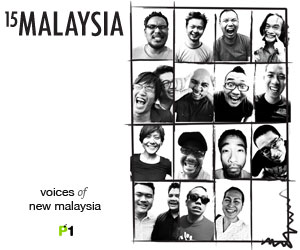
15Malaysia

You can also check them out on Youtube.
Labels: commentary, culture, films, Malaysia
Saturday, August 08, 2009
Marriage
This, Regnerus argues, tends to exacerbate rather than solve the problem. He anticipates and answers objections such as economic insecurity, immaturity and so on. Marriage is, first and foremost, a covenant, where we learn what self-sacrifical love and commitment really looks like. "Chemistry wanes. Covenants don't". Marriage is not some ready-made perfect union where you will enjoy bliss upon exchanging rings, but a place where both partners will continue to be formed in character. In conclusion, young Christian couples who are maturing in their faith should be encouraged towards marriage.
Does a right, biblical view of marriage necessarily incline one towards early marriage? Maybe, maybe not. Certainly in my church circles, I would say people get married earlier than average, and that some definitely encourage this.
But whatever you think, Regnerus is absolutely right to point out that all too often, our views of marriage are misshappened. I know I want to claim that Hollywood and novels and pop music have not affected me one iota. Considering I just went "awww" this morning at this Sleepless in Seattle story while chomping on some bacon, I'll say my claim doesn't exactly rest on solid foundations.
Historically, Christians have given three answers to the purpose of marriage, as I only found out recently. There are
1. procreation
2. intimacy
3. societal order
with Roman Catholics typically majoring on the first and Protestants the second, and no one really wanting to champion the third! All three can be biblically supported. So although romance and chemistry has been downplayed somewhat in this post, they're clearly a gift that God blesses his world with, and married couples should not be ashamed to delight in it.
But all of this needs to be understood within a covenantal framework. That is, marriages are not in service to us, but in service to God. Marriages are not just about what goes on in the bedroom, but how they function as a social and family unit. Christopher Ash, who has thought about this subject deeply, shows this from a sensitive and compelling reading of Genesis 1 and 2*. I take it Regnerus agrees with him.
To be honest, I haven't thought about the whole "what is the nature of marriage" question at any length before, and the only reason I've dwelt on it more recently was due to one or two pastoral situations that arose this past year. (Isn't that usually the case?) It's very counter-cultural to my own thinking.
I'm still not completely sure if that mandates early marriage. I remember at a conference early this year, there was a "you should definitely be thinking about marriage" line handed down to all of us (who were mostly in early to mid-20s). But in many cases, most people were already seeking to get married. The question then becomes, are you being too fussy? Well, maybe. But maybe not. I don't think that it was necessarily wrong to encourage marriage. That is, to engender courage in people that getting married isn't a bad thing and you can trust God! But perhaps a parallel emphasis that singleness is also a gift from God was needed.
But I'm starting to get somewhat off-track. Anyway, an important subject to think about.
*Christopher Ash has written both a weighty theological tome on the subject, simply entitled Marriage, and a book for laypeople, Married for God. I've only read the latter. He has also written an excellent summary article for the Christ on Campus Initiative.
† Expand post
Labels: commentary, culture, links, personal reflections, theology
Monday, August 03, 2009
Footnotes
- Eugene Peterson, Run with the Horses (cited in From Why to Worship, Jonathan Lamb, p.41)
Labels: Bible reading, culture, quotes
Monday, July 20, 2009
Taking stock
"My dear brothers, take note of this: Everyone should be quick to listen, slow
to speak and slow to become angry, for man's anger does not bring about
the righteous life that God desires. Therefore, get rid of all moral filth and
the evil that is so prevalent and humbly accept the word planted in you,
which can save you." (James 1:19-21 TNIV)
If you are a follower of Jesus in Malaysia, you are probably angry. Consider
the following...
Read the whole thing.
Labels: commentary, culture, Malaysia
Friday, July 17, 2009
Alpha
Still, it's always interesting to see how Christians are perceived, and always just as interesting to see what sort of questions non-Christians have. There was the line about religion being all about inclusivity, whether Christianity was really more of a psychological experience, and the person who found Jesus off-putting. Disappointingly, the show actually didn't dwell that much on the small group time, preferring, somewhat understandably, to dwell on the various agnostics and their backgrounds instead.
The narrator concluded that Alpha, in the end, was "organised niceness", run by decent people, with just that weird element of trying to get people to speak in tongues on the weekend (I'm afraid I'm not sold on this idea, looking at 1 Corinthians 14?) What the programme does show is that people do have real questions, and that not everyone is a New Atheist™. I was slightly disappointed by the way in which some of the answers seem to have been answered. But the programme only provided a few glimpses of such moments, so it's unfair to judge them on such scant evidence.
There have recently been some questions about whether things like Alpha or Christianity Explored are out of step with the times, and more importantly, whether they come across as being too much like a "package". My own thinking at the moment is that, like most things, they have their place. What we must work hard at is getting our bearings right. So, it isn't a short-cut, nor is it a synonym for evangelism, or indeed, the power and source of salvation.
I am not ashamed of the gospel, because it is the power of God for the salvation of everyone who believes: first for the Jew, then for the Gentile. For in the gospel a righteousness from God is revealed, a righteousness that is by faith from first to last,[a] just as it is written: "The righteous will live by faith".
Romans 1:16-17
Labels: commentary, culture, personal reflections
Sunday, May 10, 2009
Religion and the public square at Veritas
As you can imagine, the debate was pitched at a pretty high-level, and it took supreme effort on my part to concentrate. I didn't take any notes either, so I'm afraid there won't be any blow-by-blow account of the evening here! But it was certainly interesting. I was especially intrigued by Tariq Ramadan. His opening statement (all the speakers were given 5 minutes to make one) was essentially a lecture in hermeneutics, where he went on for a little bit about the need for context. He also distinguished between two authorities - here I lost him a little because either he was mumbling or my seating position wasn't great for the acoustics - but it seemed to me like he endorsed some version of a public/private split. I can't remember the exact phrase now, but he did have some pithy statement on the relationship between principles and ethics; basically, he defended his right to believe while accepting the need to negotiate with rival traditions in the public square.
But his biggest point, which he repeated throughout the evening, was the need to be consistent with one's own values. And after setting such a high standard for himself, he failed to meet it, it seemed to me. On the one hand, he would uphold "universal values" such as equality, but on the other hand, he would revert to some form of social constructivism at points. The other thing I struggled with was figuring out how distinctively Islamic Professor Ramadan's position was. I knew he belonged to the reformist camp within Islam, but I don't remember him quoting the Quran even once, or using Islamic doctrine as a springboard, although Bishop Nazir-Ali, more than once, invited him to do so. In some ways, I almost wonder if his views could have come from a secularist, although that's probably overstating it, and I'm sure Professor Ramadan would insist he is working within an Islamic framework. For him, the thing most needed in the Muslim world was simply more education. By contrast, both Bishop Nazir-Ali and Rabbi Dr. Brawer were not afraid to use the Torah/Talmud and the Bible as sources for their reflections, as they should. I don't think I was the only one who thought so, during the Q&A, a Muslim student in the audience challenged Professor Ramadan to show how his views were part of mainstream Islamic thought. (Obviously, I have insufficient knowledge to make a judgment).
Dr. Brawer was arguably the clearest of the speakers, but also the least interesting, as he didn't really say all that much. Bishop Nazir-Ali, I thought, acquitted himself pretty well. Although there was a point in the discussion where it was all about just war, and I wasn't sure if that was just a tangent. Towards the end of the evening, we got an especially sharp disagreement on what constituted "Judeo-Christian tradition" and its impact on European civilisation. Professor Ramadan insisted that the contribution of Islam to Europe must not be overlooked, whereas Bishop Nazir-Ali defended the Judeo-Christian tradition as necessary to provide the necessary undergirdings for Europe as they cope with the challenges of the future. To put it another way, Bishop Nazir-Ali thinks that we need a Judeo-Christian foundation if we want an increasingly plural society to remain inclusive. (Nazir-Ali had earlier made a distinction between civic and religious pluralism, which I think is an important one)
Like I said, it was a sprawling discussion, and certainly quite academic, so I'm not even sure if I represented anyone fairly! But this continues to be an important topic, especially as mainstream commentators are beginning to recognise that God is back on the agenda.
† Expand post
Labels: commentary, culture, personal reflections, politics, The Bible and Other Faiths
Wednesday, April 08, 2009
Takeaways from the getaway: on thinking about other religions
I ran the seminar 3 times over the week, and each time I started by asking why people were in my seminar. They fell primarily into 2 camps: one camp felt as if they had absolutely no knowledge on the subject, and so wanted more information. One or two of them were perhaps motivated by the increasingly multi-cultural nature of British society. The other camp were those who would inevitably say, "I have a friend who is..." and so they wanted to, essentially, know how to be a good Christian and friend.
I then tried to show that while we had all sorts of good questions and agendas in coming to the seminar, and indeed, to the Bible, it would be helpful to begin from another starting point. In essence, before asking our questions, I wanted us to take a step back and proceed to ask, what is the biblical story? After all, if we call ourselves Christians, we would inevitably want to take the Bible as our authority, our foundational story. But just as importantly, I wanted people to see that the Bible wasn’t just a 'Christian' book, but made even grander claims than that. It claims for itself that it is the narrative of everything, from the beginning to the end of history. It focuses in on particular individuals, families and nations, but it is actually telling the story of humanity. And so the Bible is for all peoples, of every religious background, of every age. To ram home the point, I included this great quote from a Hindu scholar to Leslie Newbigin, a missionary in India for many years and who’s written extensively on the topic of mission – some of my readers might be familiar with him. This Hindu scholar said:
"I can’t understand why you missionaries present the Bible to us in India as a book of religion. It is not a book of religion – and anyway we have plenty of books of religion in India. We don’t need any more! I find in your Bible a unique interpretation of universal history, the history of the whole creation and the history of the whole human race. And therefore a unique interpretation of the human person as a responsible actor in history. That is unique. There is nothing else in the whole religious literature of the world to put alongside it."And so the Bible, while not necessarily answering every single specific question we have, nonetheless gives us fixed points in our reflections on this question. It gives us the shape of the story we’re in.
I then went through 4 questions:
1. Who is God?
2. Who are we?
3. What’s gone wrong?
4. What’s God plan for the world?
And tried to go through these questions in light of the issue of other religions. Let me highlight how I tried to do this with the first question. Firstly, I went to Psalm 97, and asked what we learnt about God from it. From Psalm 97, and from quite a few of the other psalms, especially those that stress God’s kingship, we can learn quite a bit! I then asked how what we learn about God here impacts how we think about other religions. What does the truth, for example, of God as God of all nations shape our thinking? Or the fact that there is only one God? I argued that (although I have to confess I’m not completely sure if this is that explicit in Psalm 97!) that we find both a challenge and an invitation to adherents of other religions. Another way of putting it, which I learnt from my seminar co-leader, is "subversive fulfilment" (which might also be borrowed from Newbigin!). The gospel comes as fulfillment of the religious longing in the heart of humankind. Yet the gospel also stands in contradiction to human wisdom twisted by sin.
I then went to Acts, and one example of how Paul allowed this fixed point to shape his engagement with people of other religions. In Acts 14:8-18, we find the story of Paul and Barnabas in Lystra, where they perform a healing. Immediately news spread and they are feted as gods. And so Paul uses this as a preaching opportunity. But he does so aware of his audience, who would have been pagans who followed traditional Greek popular religion. Earlier on in Acts 13, he had preached to a Jewish audience, but he can’t employ the same rhetorical methods here.
So he begins with common ground, with their shared humanity (v.15), correcting their mistaken notions in the process. He then proclaims the truth that there is one Creator God (v.15b), and indeed He is a God who is sovereign over all the nations (v.16). He then moves on to the truth that God has revealed himself (v.17), that He is the provider and sustainer of life. That would particularly resonate with his hearers, from an agrarian culture, but implicitly it posed a challenge too, since that meant Zeus, the god of vegetation and weather, whom they worshipped, wasn’t in control! Paul had mixed results (v.18-19).
And so I did the same with the rest of the questions (although I think my one on sin was quite superficial!). If we’re all made in the image of God, then surely we need to think of all human beings in that sense first before we think of them as Hindu/Muslim etc. If God left us with a cultural mandate in Genesis 1:26-28, then surely it is right to celebrate aspects of culture which are not blasphemous, although the question of how to disentangle culture from religion is a much more complex one which I steered away from! And so on.
I suppose one thing I realised and would have liked to rectify in my seminar was that Jesus did get sidelined a little. One of the interesting things in Paul’s sermon in Acts 14 is that he doesn’t mention Jesus at all, but I’m pretty sure he would have eventually got there if he had time and opportunity. But he needed to lay the ground first with people whose worldviews must have been radically different from his.
Jesus is mentioned, of course, in question 4, but otherwise I didn’t really think through how he would have fitted in. In John Dickson’s book, A Spectator’s Guide to Other Religions, he has an interesting chapter near the end called “What’s Wrong with Jesus?” in which he shows how Jesus just doesn’t fit into any of the other religions various doctrines or ethics or philosophies, and that’s one way to do it. I recommended John’s book in the seminar, btw, and I was interested to notice that it sold out at the bookstore by the end of the week! I should be in marketing...
One other thing I’ve learnt, 75 minutes is pittance. Not once in the three times I ran my seminar did we get through all our material. Admittedly I was pretty interactive and so allowed people to come back at me rather than rigidly stick to what was in my outline. But still, it’s amazing how quickly time flies! The second time I ran it was probably the smoothest, probably because people seemed to have their expectations adjusted accordingly.
Well, it’s the first time I’ve done anything like this, and so it was a good learning experience. I’m not sure how much I helped students - I certainly hope so!
† Expand post
Labels: Bible reading, culture, missions, The Bible and Other Faiths
Thursday, April 02, 2009
Servant of God, or, what one evangelical looks like to the world
I'm always fascinated by how the media portrays evangelicals/evangelicalism*. I think part of it is because I'm interested in the medium itself, and as an evangelical, I am also naturally curious about how I'm perceived by the world at large. Of course, at the same time, it can be a bit of a risky exercise, since it can leave you feeling incandescent with rage or self-pity when you feel (inevitably?) misrepresented! Hey, we evangelicals have a strong doctrine of sin after all! :-p Still, I gave in when I saw that BBC3 had a documentary following a British teenage evangelical, and caught in on the internet. The above is Part 1 of 6, all of which you can find on Youtube.
It's actually quite fair-minded, and by the end of it, I confess to feeling even a little proud of Deborah. She's probably the most mature 13 year old I've ever seen! Their family looks pretty level-headed, and it's quite refreshing to discover that not knowing who Posh Spice isn't going to destroy your life.
Now I'm sure most of us can also spot some of the negatives. It's quite easy, and valid, to pick on her gospel presentation. A lot of us nowadays cringe at something that sounds nothing more than fire insurance, which is what her gospel outline sounds like. Remember though, she's 13! So the hope is as she grows up, she would receive some neccessary biblical corrective teaching on whole-life discipleship. Deborah, do read C.S Lewis's essay 'Learning in War Time' at some point! She's also obviously got a very sensitive and caring nature, and there is a danger where the doctrine of hell could overwhelm her in a way that could be damaging. The other thing that caught my attention was how much "Christianese" there was, which must sound completely alien to anybody that's unchurched.
But at the end of it, I was struck by her boldness, which nonetheless was never expressed in an arrogant spirit - quite the opposite. And I was really interested that a lot of the people she spoke to weren't put off by her, although they probably found what she had to say hard to swallow. In one sense, her age was an advantage. And I was also struck by how much influence her family must have played in her character. Negatively, this could be construed as "brainwashing", as the more charitable comments of skeptics on youtube put it. Positively, though, her level-headedness could also be attributed to the benefits of a stable upbringing, which is increasingly less true of many British teenagers today. There's certainly some truth in the fact that she's culturally conditioned, but then, aren't we all?
Now this documentary isn't going to change anyone's presumptions about what evangelicals are like. But it's good every once in a while to inhabit someone else's eyes and see what strange creatures we are! And to, in spite of our warts and all, not be too quick to see only the bad in evangelicalism*, but rejoice in some of our positives as well.
*in this case, Western evangelicalism, since obviously, Asian evangelicalism wouldn't quite look the same!
Labels: commentary, culture, personal reflections, the church